Unit 7 – Circulatory System - The Blood - Class Lecture
Notes
 Normally, 7 to 8% of human body weight,
the volume of blood in the body is about six liters. Blood is about 22% solids
and 78% water. The temperature of blood in the body is 38oC (100.4oF),
slightly higher than body temperature. Blood is slightly alkaline, with a pH
between 7.35 and 7.45.
Normally, 7 to 8% of human body weight,
the volume of blood in the body is about six liters. Blood is about 22% solids
and 78% water. The temperature of blood in the body is 38oC (100.4oF),
slightly higher than body temperature. Blood is slightly alkaline, with a pH
between 7.35 and 7.45.
|
Blood takes these |
Blood takes these |
|
|
Blood is a
highly specialized tissue composed of many different kinds of components
produced in bone marrow. Four of the most important ones are red cells, white
cells, platelets, and plasma. All humans produce these blood
components - there are no racial or regional differences.
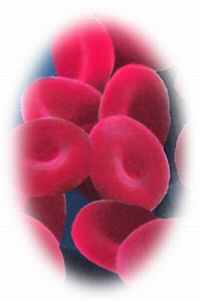
- Red blood cells, or erythrocytes,
RBCs, are relatively large microscopic
cells without nuclei. These cells normally make up 40-50% of the total
blood volume. They transport oxygen from the lungs to all of the living
tissues of the body and carry away carbon dioxide. Hemoglobin, Hb is the gas transporting protein molecule that
makes up 95% of a red cell. Each red cell has about 250 million iron-rich
hemoglobin molecules. The number of RBCs varies,
but the average is about 5 million cells per cubic centimeter (cm3).
Although the numbers are important, it is the amount of hemoglobin in the
blood at any time that really determines how well oxygen is transported.
Developing RBCs divide many times and then begin synthesizing huge amounts of hemoglobin. Suddenly, when enough hemoglobin has been accumulated, the nucleus and most organelles are ejected and the cell collapses inward. Because they are anucleate, without a nucleus, the mature cells are unable to sunthesize proteins, grow, or divide. As they age, RBCs become more rigid and begin to fragment in 100 to 120 days. Their remains are removed from the blood by phagocytes in the spleen and liver and their components recycled.
- White blood cells, or leukocytes,
WBCs exist in variable numbers and types
but make up a very small part of blood's volume - normally only about 1%.
Some white cells (lymphocytes) provide a physiological defense against
infection by seeking out microscopic parasites and destroying them. Their
numbers increase when the body is under attack by bacteria, viruses,
fungi, or other parasites. Some white cells (macrophages) are the blood's
disposal units. They have the function of getting rid of old, unneeded
blood cells as well as foreign matter (dust and bacteria). A total WBC
count above 11,000 cells/cm3 is
referred to as leukocytosis, and
generally indicates a bacterial or viral infection. Individual white cells
remain viable for only 18 to 36 hours.
The several types of white blood cells are classified into two major groups, depending on whether or not they contain visible granules in their cytoplasm.
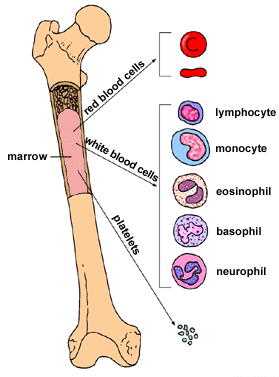
- Granulocytes are
granule-containing WBCs:
- Neutrophils have a multilobed
nucleus and very fine granules. They are avid phagocytes at sites of
acute infection.
- Eosinophils have a blue-red nucleus and large
brick-red granules. Their numbers increase rapidly during allergies.
- Basophils, the rarest of all WBCs,
contain large histamine-containing granules. Histamine is an
inflammatory chemical that makes blood vessels leaky and attracts other WBCs to the inflammatory site.
- Agranulocytes do not have visible cytoplasmic granules:
- Lymphocytes have a large
dark purple nucleus that occupies most of the cell volume. Lymphocytes
reside in lymphatic tissues and are the first immune response of the
body.
- Monocytes are the largest of WBCs.
When they migrate into the tissues, they change into macrophages with an
important role in fighting chronic infections.
- Platelets, or thrombocytes, are cells that clot blood at the
site of wounds. Platelets are not cells in the strict sense. The are fragments of multinucleated cells called megakaryocytes, which rupture, releasing
thousands of "pieces" that quickly seal the leak in the blood
vessel. There are more than a dozen types of platelets that need to
interact in the blood clotting process. Individual platelets are about 1/3
the size of red cells. The normal platelet count in blood is about
300,000/cm3. Platelets have a lifespan of 7 to 10 days.
- Plasma is the
relatively clear liquid medium which carries the red cells, white cells,
and platelets. Most of our blood's volume is made up of plasma. About 95%
of it consists of water that is as salty as the oceans. As the heart pumps
blood to cells throughout the body, the plasma brings them nourishment and
removes the waste products of metabolism.
- Other Blood Components:
- Chemical
substances, including; fat, carbohydrates, proteins, and hormones.
- Gases,
including; oxygen, carbon dioxide, and nitrogen.
Blood Types:
Sometimes
when the blood of two people is mixed together, the red blood cells clump
together in the liquid plasma. This is agglutination. This is not the
same thing as clotting. When agglutination occurs, the blood mostly remains
liquid. With clotting, however, it does not.
The
difference in composition between blood types is in the specific kinds of
antigens found on the surface of the red cells. Antigens are relatively
large protein molecules that provide the biological signature of an
individual's blood type.
Within
blood there are substances called antibodies which distinguish
particular antigens from others, causing hemolysis,
bursting, or agglutination of the red cells when alien antigens are found. The
antibodies bind to the antigens. In the case of agglutination, the antibodies
glue together the antigens from different red cells thereby sticking the red
cells together.
The
specific type of antigens on red blood cells determine
blood types. There are 27 known human blood groups, for which each of us
can be typed.
Long
before the blood antigen-antibody interaction was discovered, surgeons
experimented with transfusions in an attempt to save the lives of
patients who were dying from severe blood loss and the resulting shock. The
first attempt may have been an English physician during the mid-17th century who infused a wounded soldier with sheep blood. Not
surprisingly, the soldier suffered a painful death. During the 19th century,
European and American doctors used transfusions in a last ditch attempt to save
soldiers and other patients with severe wounds. They usually transferred blood
directly from a healthy individual to their patient via a rubber tube with
hypodermic needles at each end. This occasionally resulted in success but more
often than not killed the recipient. The results seemed to be random. Doctors
in the 19th century also experimented with a variety of blood substitutes,
including milk, water, and even oils. It was the discovery of the ABO blood
types in 1900 that finally led us to understand how to consistently use
transfusions to save lives.
|
ABO Blood Groups |
|||
|
Blood Group |
RBC Antigen |
Plasma Antibody |
Blood that can be
received |
|
AB |
A
and B |
None |
A,
B, AB, and O |
|
B |
B |
Anti-A |
B
and O |
|
A |
A |
Anti-B |
A
and O |
|
O |
None |
Anti-A
and Anti-B |
O |
|
Frequency of Blood
Groups, % of |
|||
|
Blood Group |
White |
Black |
Asian |
|
AB |
4 |
4 |
5 |
|
B |
11 |
20 |
27 |
|
A |
40 |
27 |
28 |
|
O |
45 |
49 |
40 |
The Rh blood groups are so named because one of
the eight Rh antigens (agglutinogen
D) was originally identified in Rhesus monkeys. Most Americans are Rh+ (Rh positive),
meaning that the RBCs carry the Rh
antigen. Blood without the antigen is Rh -
(Rh negative).
Before a
transfusion today, blood is typed and cross-matched, involving 3 basic
steps:
- Determine the ABO
group
- Determine the Rh factor
- Test for
agglutination of the donor RBCs by the
recipient's serum and of the recipient RBCs by
the donor's serum.
When blood is donated for future use, the usual blood bank
procedure involves mixing it with an anticoagulant to prevent clotting. The
treated blood can be stored (regrigerated at 4oC)
for about 35 days.
Because of
its absolute importance to life and its relatively short
"shelf-life", blood is a priceless commodity. The U.S. Food and Drug
Administration has encouraged the development of
artificial blood for over 20 years. While no marketable product has been
produced, several companies are close to developing effective human blood
substitutes. These substitutes consist of either synthetic chemicals called
perfluorocarbons or modified hemoglobin
extracted from cows' blood and unused human blood that is too old for
transfusing. The advantage of these blood substitutes is that they do not have
antigens that would cause rejection. The disadvantage is that blood substitutes
are filtered out by kidneys in only a few days and patients may then need a
whole blood transfusion.
Blood cells are made in the bone marrow. Bone
marrow is the spongy material in the center of the bones that produces
about 95 percent of the body's blood cells. In adults, the blood-producing
marrow is found mainly in the flat bones of the skull, pelvis, ribs, and
sternum.
The
production and development of new blood cells is a process called hematopoiesis. All blood cells formed in the bone
marrow start out as a stem cell or hemocytoblast.
Stem cells differentiate into either lymphoid stem cells (which produce
lymphocytes) or myeloid stem cells (which can produce all other classes
of blood cells). The entire development process from hemocytoblast
to mature blood cell takes 3 to 5 days.
Farther
differentiation of stem cells is controlled by four hormones:
- Erythropoietin controls the
rate of RBC production. Normally a small amount of this hormone circulates
in the blood at all times, and RBCs are formed
at a fairly constant rate. Although the liver produces some, the kidneys
play the major role in producing erythropoietin.
- Colony stimulating factors, CSFs and interleukins stimulate the
production of WBCs.
- Thrombopoietin accelerates the
rate of platelet production.
Hemostasis is the
process by which blood flow is stopped at the site of a break in a blood
vessel.
When a blood vessel breaks, three things happen in rapid sequence:
- Platelet plug formation
1. Collagen fibers are exposed when a
vessel breaks. This causes platelets to rupture, sticking to the damaged site
and releasing chemicals that attract more platelets, forming a plug.
- Vascular spasms
2. Once anchored, the platelets release serotonin,
causing the blood vessel to go into spasms. The spasms narrow the blood vessel
at the site, decreasing blood loss until clotting can occur.
3. At the same time, the injured tissues
release thromboplastin in preparation for
clotting.
- Coagulation (blood clotting)
4. PF3, a chemical coating the
surfaces of platelets, interacts with thromboplastin,
and Ca+2 to form a prothrombin activator
that triggers the clotting cascade.
5. The activator converts prothrombin, present in the plasma, to thrombin,
an enzyme.
6. Thrombin joins soluble fibrinogen
proteins into long hairlike molecules of insoluble fibrin,
which forms a mesh that traps RBCs and forms the base
of the clot. Within an hour, the clot begins to retract,
squeezing serum (plasma minus the clotting proteins) from the mass and
pulling the ruptured edges of the blood vessel closer together.
Normally, blood clots within 3 to 6 minutes. As a rule, once
the clotting cascade has started, the triggering factors are rapidly
inactivated to prevent widespread clotting. Once the clotting cascade was
understood, it became clear that placing a sterile
gauze over a cut or applying pressure to a wound would speed up the clotting
process. The gauze provides a rough surface to which the platelets can adhere,
and the pressure fractures cells, increasing the release of thromboplastin
locally.
A complete
blood cell count, CBC is a measurement of size, number and maturity of the
different blood cells in a specific volume of blood. A complete blood cell
count can be used to determine many abnormalities with either the production or
destruction of blood cells. Variations from the normal number, size, or
maturity of the blood cells can be used to indicate an infection or disease
process.
- Often with an
infection, the number of white blood cells will be elevated.
- Many forms of
cancer can affect the bone marrow production of blood cells.
- An increase in
the immature white blood cells can be associated with leukemia.
- Anemia and sickle
cell disease will have abnormally low hemoglobin.
Normal red
blood cells are flexible and disk-shaped, thicker at the edges than in the
middle. In several inherited disorders, red blood cells become spherical, hereditary
spherocytosis, oval hereditary elliptocytosis, or sickle-shaped sickle cell disease.
